Cracked Heat Exchanger: When to Replace Your Furnace
Cracked heat exchanger? Learn when it’s a safety emergency, when repair makes sense, when to replace the furnace, and what info your HVAC pro needs for a fast quote.
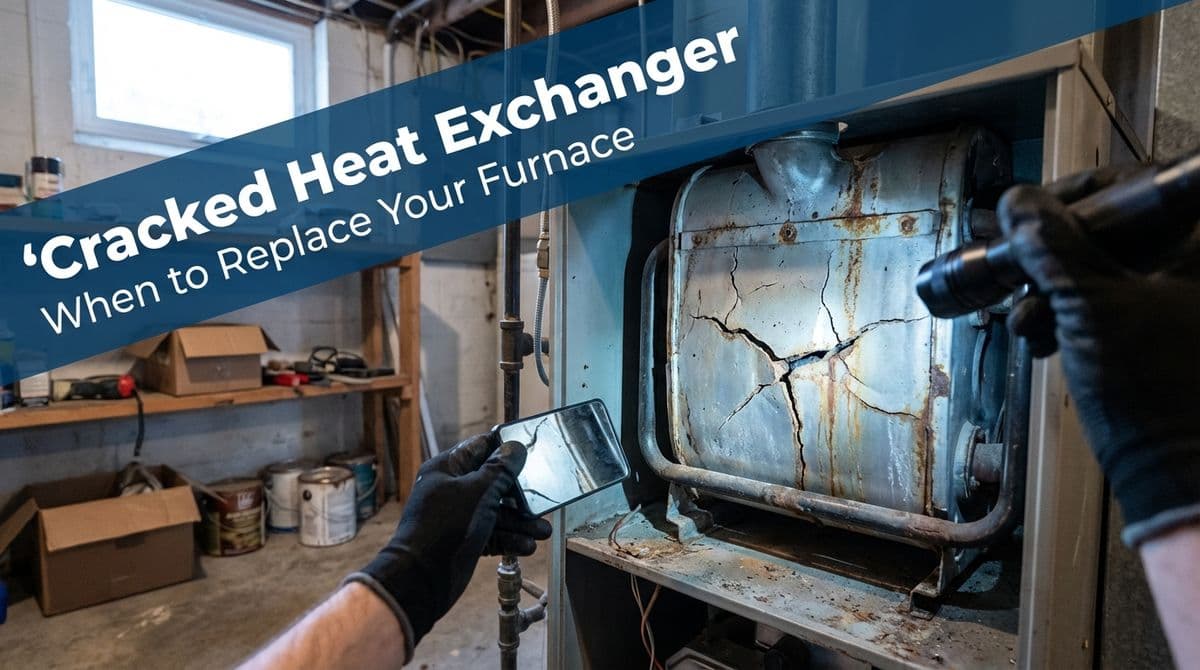
When a “Bad Heat Exchanger” Turns Into a Furnace Replacement
We recently got a call from a customer — let’s call her Kelly — who was managing a flip property. Earlier in the week, the heat was working fine. By Friday, the house was cold, so she called a local HVAC company to take a look.
They inspected the furnace, an older Armstrong Ultra 90 from the mid-90s, and told her the heat exchanger was bad and the furnace needed to be replaced. The problem? They were booked a couple of weeks out, and she needed heat right away.
When Kelly called us, she had a few big questions: How serious is a cracked heat exchanger? Do I really have to replace the whole furnace? What information do you need from me to get a quote and get this done quickly? If you’re asking the same things, you’re not alone.
Why a Cracked Heat Exchanger Is a Serious Safety Issue
The heat exchanger is the sealed metal chamber where your furnace burns gas and transfers heat to the air that blows through your ducts. Under normal operation, combustion gases (including carbon monoxide) stay inside that chamber and are vented safely outside.
When the heat exchanger cracks or rusts through, those combustion gases can mix with the air that circulates through your home. That’s where the real danger lies.
- Carbon monoxide risk: A cracked exchanger can allow CO into your living space, which is odorless, colorless, and potentially deadly.
- Fire hazard: In severe cases, flames can “roll out” of the burner area if the exchanger is badly compromised.
- Code and liability issues: Most reputable HVAC companies will red-tag (shut down) a furnace with a confirmed cracked exchanger for safety and legal reasons.
That’s why, in Kelly’s case, once we knew a trusted local company had documented a bad heat exchanger, we treated it as a no-heat / safety-priority situation.
Repair vs. Replacement: Do You Always Need a New Furnace?
Homeowners often ask, “Can’t you just replace the heat exchanger?” Technically, yes — but in reality, it’s rarely the smartest move, especially on an older unit like Kelly’s Ultra 90.
When replacing just the heat exchanger might make sense
- Furnace is relatively new (typically under 10–12 years old).
- Parts are still supported and available from the manufacturer.
- Heat exchanger is under warranty (often 20 years or lifetime on higher-end models).
- The rest of the furnace is in excellent condition.
In that narrow situation, paying for labor to swap a warranted heat exchanger can be cost-effective.
When a full furnace replacement is the better choice
In Kelly’s case, the Armstrong Ultra 90 was roughly 30 years old and the model wasn’t even made anymore. That’s exactly when replacement is usually the better investment:
- Age: Over 15–20 years old is “bonus time” for most furnaces.
- Efficiency: Old 80–90% units cost more to run than modern high-efficiency models.
- Parts availability: Obsolete models can be slow or impossible to repair.
- Labor cost: A heat exchanger replacement is labor-heavy and can run close to the cost of a new unit.
For Kelly, we talked through it and focused on a like-for-like BTU replacement with a modern, efficient furnace that would heat the 1,600 sq. ft. main level properly and be ready for the potential 800 sq. ft. walkout basement in the future.
What Information Your HVAC Pro Really Needs
One thing that helped us give Kelly a fast, realistic quote over the phone was the specific info she had — and what she could quickly track down. If you’re facing a cracked heat exchanger and possible replacement, here’s what your HVAC pro will ask for.
1. Photos of the furnace and nameplate
We asked Kelly to text pictures of the furnace, including the data sticker (usually on the inside of the blower door). From those photos, we can usually get:
- Brand and model (e.g., Armstrong Ultra 90).
- Input BTUs (60,000, 80,000, etc.).
- Fuel type and approximate age.
Even a blurry photo is better than a guess.
2. Home size and layout
Kelly’s property was about 1,600 sq. ft. on the main level plus an unfinished walkout basement of roughly 800 sq. ft. We also asked whether there was ductwork to the basement and learned it stayed chilly and had a wood burner — a good clue that the main ducts served mostly the upper level.
This kind of information helps us estimate whether the existing furnace size (in BTUs) is roughly right or if we should double-check sizing more carefully.
3. Verification of the diagnosis
We also asked who had inspected the furnace. In Kelly’s case, it was a local company we know and trust. If another reputable contractor has already confirmed a cracked heat exchanger, we don’t typically “argue with the red tag” — we move straight into replacement planning.
Cost, Timing, and What “All-In” Should Include
Based on the size of Kelly’s home and the likely BTU range (60,000–80,000 BTUs), we were able to give a ballpark replacement price over the phone — right around $5,500, assuming a standard installation.
For most straightforward gas furnace swaps, a replacement quote should outline:
- Removal and disposal of the old furnace.
- New furnace (brand, efficiency, and BTU rating).
- Reconnecting gas, venting, electrical, and ductwork.
- Startup, testing, and thermostat hookup.
- Warranty details and any required permits.
When we tell a customer, “You turn on the thermostat and the new one is ready to go,” that’s what we mean — no surprise add-ons after the fact.
Don’t Forget Warranty and Efficiency Choices
A cracked heat exchanger is also the moment to look closely at warranties and efficiency levels, not just the upfront price.
Heat exchanger and parts warranties
- Heat exchanger: Many quality furnaces carry a 20-year or lifetime heat exchanger warranty.
- Parts: Typical parts warranties range from 5–10 years.
- Labor: Ask whether the installer offers their own labor warranty on top of manufacturer coverage.
Registering the unit after installation is critical; your HVAC pro should walk you through that so you don’t miss out on coverage.
Choosing an efficiency level
When we help someone like Kelly choose a replacement, we usually walk through options such as:
- Standard efficiency (80% AFUE): Lower upfront cost, typically vented into a chimney; common in some existing homes.
- High efficiency (90–96%+ AFUE): Higher upfront cost, uses PVC venting, but can significantly reduce gas bills in colder climates.
The “right” choice depends on how long you’ll own the home, local fuel costs, and whether venting upgrades are practical. With flip properties, owners often balance resale appeal with cost and timeline.
What to Do If You’re Just Hearing “Cracked Heat Exchanger”
If a technician has just shut down your furnace and mentioned a cracked heat exchanger, here’s how to move forward:
- Take it seriously — don’t bypass safety switches or keep running the furnace.
- Ask for documentation — photos or a written note of the diagnosis if possible.
- Gather info — pictures of the furnace, model/serial number, and your home’s square footage.
- Call an HVAC pro you trust and share that information up front so they can give you realistic options and timing.
That’s exactly what Kelly did, and it allowed us to fast-track a properly sized, safe replacement furnace and get heat back on at her property within the week.
If you’re in a similar situation and unsure whether to repair or replace, we’re always happy to look at the age, condition, and warranty of your system with you — and help you choose the safest, most cost-effective path forward.